
Global spending on cybersecurity and risk management technology continues to rise annually, yet the frequency and severity of data breaches show no sign of slowing down. This disconnect highlights a fundamental misunderstanding in modern business: the confusion between purchasing security tools and achieving a robust security posture.
A firewall is a tool. Security posture is a state of being.
Cybersecurity posture represents the collective security status of an organization’s software, hardware, networks, services, information, and people. It is not a static measure of which software is installed, but a dynamic assessment of how ready the organization is to predict, prevent, detect, and respond to threats. While compliance ensures a company adheres to legal standards, security posture determines whether the company can survive a targeted attack.
The Failure of Point-in-Time Assessments
Historically, organizations relied on the annual penetration test or the quarterly compliance audit to validate their cybersecurity. In the era of on-premise data centers, where changes occurred slowly, this was acceptable. In the modern cloud-native era, this approach is obsolete.
Infrastructure today is immutable and ephemeral. Developers spin up containers and serverless functions that may exist for only minutes. Third-party API connections are established and discarded rapidly. A security report delivered on Monday is often factually incorrect by Tuesday due to the natural rate of change in the IT environment. This phenomenon is known as configuration drift.
Configuration drift occurs when ad hoc changes to software settings accumulate, causing the system to deviate from its hardened baseline. Without continuous monitoring, these minor changes create security gaps that remain invisible to the IT team until the next audit. A robust security posture abandons the snapshot model in favor of Continuous Threat Exposure Management (CTEM). This framework prioritizes the continuous discovery and remediation of high-risk exposures rather than simply checking boxes for a compliance auditor.
The Visibility Paradox: You Cannot Secure What You Cannot See
The foundation of security posture is asset inventory. However, most enterprises lack a complete understanding of their digital footprint. The expansion of Shadow IT—software and devices used by employees without explicit IT approval—has made visibility the primary challenge for Chief Information Security Officers.
When the Log4j vulnerability emerged, the organizations that suffered most were not necessarily those with weak firewalls, but those that could not identify where the vulnerable Java logging library existed within their complex ecosystems.
To maintain a strong cyber posture, organizations are moving toward Cyber Asset Attack Surface Management (CAASM). This approach aggregates data from all existing tools to provide a unified view of all assets. If an asset is unknown, it is unpatched, unmonitored, and represents an open door for attackers.
The Human Element as a Critical Variable
Technical controls form only one layer of defense. The 2023 Verizon Data Breach Investigations Report highlighted that the human element is involved in the overwhelming majority of incidents. This includes the use of stolen credentials, phishing, misuse, or simple error.
A security posture assessment that ignores organizational culture is fundamentally flawed. Sophisticated social engineering attacks can bypass millions of dollars in technical defenses by convincing a single employee to authorize a transfer or approve a multi-factor authentication request.
Modern resilience requires treating the workforce not as a liability, but as a sensor network. Organizations with high maturity track human-centric metrics, such as the reporting rate of suspicious emails, rather than just the click rate on phishing simulations.
Speed as the Ultimate Metric
In a ransomware scenario, time is the only currency that matters. The concept of Breakout Time defines how long it takes for an adversary to move laterally from the initial compromised host to other systems within the network.
Once an attacker moves laterally, the complexity and cost of remediation increase expensively. Therefore, security posture is often measured against the 1-10-60 benchmark, a standard popularized by industry leaders like CrowdStrike.
- Detect an intrusion within 1 minute.
- Investigate the nature of the threat within 10 minutes.
- Remediate or eject the adversary within 60 minutes.
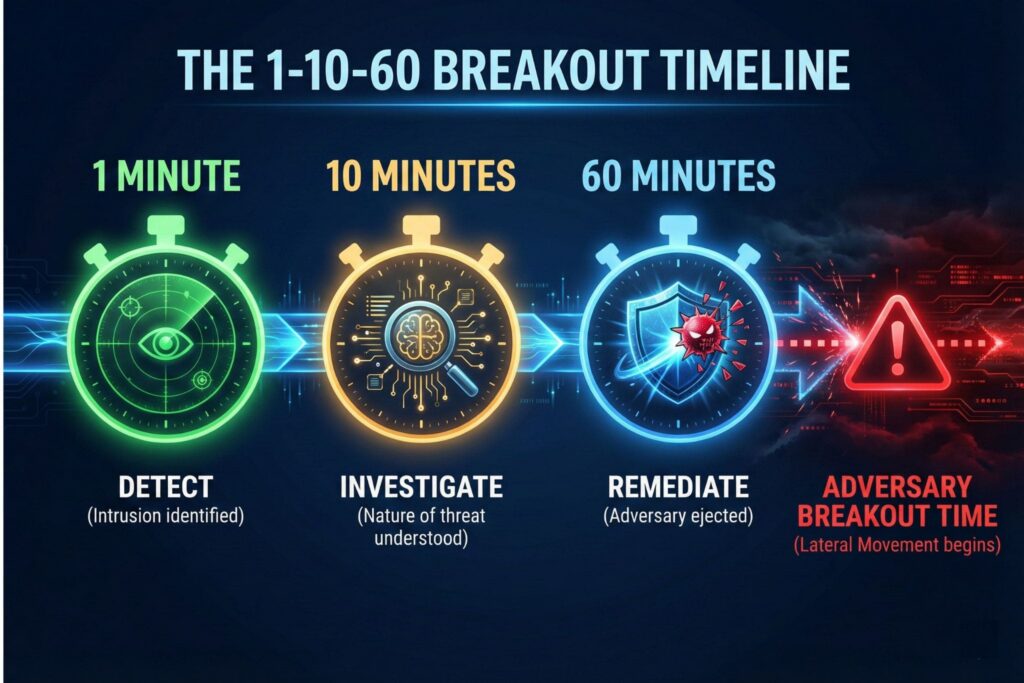
Organizations that consistently meet these timings prevent adversaries from establishing persistence. Those that rely on manual investigations often face dwell times—the time an attacker remains undetected—that span weeks or months. According to IBM data, the global average time to identify and contain a breach often exceeds 200 days, indicating a widespread weakness in detection posture.
Moving from Vanity Metrics to Outcome-Based Data
A major obstacle to improving cybersecurity posture is the reliance on the wrong performance indicators. Executives often demand reports showing high numbers to justify budget spend, but these numbers rarely correlate with risk reduction.
For example, reporting that a firewall blocked 10 million packets sounds impressive, but it is effectively meaningless noise. It describes the internet background radiation, not the effectiveness of the defense. To improve posture, leadership must transition from vanity metrics to actionable metrics that drive decision-making.
Table 1: Transitioning to Actionable Cyber Metrics
| Vanity Metric (Avoid) | Why It Is Flawed | Actionable Metric (Adopt) | Strategic Value |
| Total Alerts Generated | A high number suggests the tools are noisy and un-tuned, leading to alert fatigue. | Mean Time to Respond (MTTR) | Measures the actual speed and efficiency of the security operations center. |
| Number of Patches Applied | Does not account for criticality. Applying 100 low-risk patches is less valuable than 1 critical patch. | Critical Vulnerability Exposure Time | Measures how long high-risk assets remain vulnerable after a patch is released. |
| Audit Pass Rate | Compliance standards are minimum requirements, not proof of security against advanced threats. | Coverage of Endpoint Protection | Percentage of total corporate devices that have active, updated EDR agents installed. |
| Phishing Click Rate | Fluctuations can be random and do not measure resilience. | Reporting Rate | The percentage of employees who proactively report suspicious activity to security teams. |
| Security Budget Size | Higher spending does not automatically equate to lower risk. | Cost per Incident | Demonstrates the financial efficiency of the incident response process. |
The Strategic Shift to Zero Trust
The most effective method to harden security posture is the adoption of a Zero Trust architecture. The traditional castle-and-moat model assumed that anyone inside the corporate network was trustworthy. This assumption has been proven false by insider threats and compromised credentials.
Zero Trust operates on the principle of assume breach. It requires strict identity verification for every person and device trying to access resources on a private network, regardless of whether they are sitting within the office or connecting remotely.
By implementing micro-segmentation, organizations ensure that even if one segment is breached, the attacker cannot freely move to the data center. This limits the blast radius of an attack. A strong security posture accepts that breaches will occur; the goal of Zero Trust is to ensure those breaches remain isolated minor incidents rather than catastrophic headlines.
Security posture is not a project with a completion date. It is a lifecycle of continuous improvement. As digital ecosystems become more complex, the attack surface expands. Simultaneously, threat actors evolve their tactics, leveraging automation and artificial intelligence to scan for weaknesses at machine speed.
FAQ
Yes, compliance merely verifies adherence to minimum legal baselines at a specific point in time, whereas security posture measures the dynamic readiness to predict, withstand, and recover from active threats.
Unlike penetration tests that provide a static snapshot of security once a year, CTEM is a framework that continuously discovers, prioritizes, and validates exposures as the IT environment changes.
This performance metric sets a target to detect an intrusion in one minute, investigate in ten, and remediate within sixty minutes to prevent adversaries from moving laterally and establishing persistence.
CAASM aggregates data from all existing tools via API connections to create a unified and real-time inventory, allowing security teams to identify unpatched or unmanaged assets that would otherwise remain invisible.
Leave a Reply