

Author: James Calloway, CISSP, CISM — Senior Cybersecurity Risk Advisor with over 14 years of experience helping organizations translate technical threats into financial decision frameworks.
Organizations that invest in cybersecurity without measuring its financial impact are essentially making budget decisions on instinct. This article explains how cyber risk quantification works, why it matters to executives and boards, and how to apply it without requiring a dedicated data science team.
Cyber risk quantification is the practice of expressing cybersecurity threats in monetary terms. Rather than labeling a risk as high or medium, it estimates how much a specific cyber event is likely to cost over a defined period and how probable that event is given current defenses. The output is a financial range that finance teams, executives, and insurers can actually use.
This approach directly addresses a gap that qualitative methods leave open. When a board asks whether a proposed $3 million security investment reduces $15 million in expected losses, a heat map cannot answer that question. A quantified model can.
The concept is well-grounded in established standards. NIST Special Publication 800-37, Revision 2, frames risk assessment in mission and business terms. ISO/IEC 27005:2022 explicitly supports quantitative risk analysis methods. Cyber risk quantification operationalizes the financial side of these frameworks in a way that governance documents describe but do not fully execute.
How Quantification Models Are Built
Every credible quantification model starts with a specific, bounded scenario. A scenario such as ransomware encrypts core manufacturing systems for four days is workable. A scenario labeled data breach is not — it is too vague to produce numbers anyone can defend in a budget meeting or insurance negotiation.
A properly defined scenario identifies the affected asset or business process, the assumed attacker capability, the current control environment, and a fixed time horizon, typically 12 months. That structure is what separates analysis from guesswork.
Likelihood estimation draws on internal incident data, industry threat intelligence, and documented control effectiveness. The exact figures matter less than the transparency of the assumptions behind them. If phishing simulations show a 5 percent credential submission rate and multi-factor authentication covers 94 percent of accounts, those two numbers feed directly into a probability model for account compromise. Documenting those inputs is what makes the output auditable.
Impact modeling accounts for direct and indirect financial exposure. The most commonly modeled cost categories include business interruption and revenue loss, incident response and forensic services, regulatory penalties, customer notification costs, and revenue attrition tied to reputational damage. Not every scenario involves every category, and overstating costs to secure budget tends to permanently damage the model’s credibility with finance leadership.
The final output is typically expressed as annualized loss expectancy or a probability-weighted range of losses at different confidence intervals.
A Practical Example
A regional logistics company running a single warehouse management platform commissioned a quantification exercise after its cyber insurer requested a loss estimate. The security team modeled a ransomware scenario affecting that platform.
Their analysis showed a six-day outage would generate approximately $2.8 million in combined revenue loss and recovery costs. Based on the company’s current patch cadence, endpoint protection coverage, and backup configuration, the team estimated a 12 percent annual probability of that scenario occurring — producing an annualized loss estimate of roughly $336,000.
The insurer proposed a $290,000 premium for coverage at that exposure level. The security team simultaneously evaluated a $180,000 investment to improve offline backup frequency and reduce recovery time from six days to one and a half days. That change dropped the modeled annualized loss to approximately $78,000. Leadership approved the investment based on documented expected loss reduction rather than a risk rating change. The insurer subsequently revised the premium downward.
This outcome reflects what quantification is designed to produce — a shared financial language between security, finance, and external stakeholders.
Where Quantification Fits in Governance
The NIST Cybersecurity Framework 2.0, published in 2024, positions governance and risk management as foundational functions. Quantification provides a method for connecting framework maturity levels to specific financial outcomes — a translation the framework requires but does not perform on its own.
Regulatory pressure is reinforcing this direction. The U.S. Securities and Exchange Commission now requires public companies to describe material cybersecurity risks and governance processes in annual filings under rules adopted in 2023. The rules do not mandate quantification specifically, but organizations that can express risk in financial terms are better positioned to support materiality assessments and demonstrate board-level oversight.
For quantification to function inside an organization, ownership must cross functional boundaries. Security teams define scenarios and control assumptions. Risk management validates the methodology. Finance reviews cost modeling inputs and challenges assumptions that cannot be substantiated. Executive leadership sets the risk tolerance thresholds that determine what level of expected loss is acceptable.
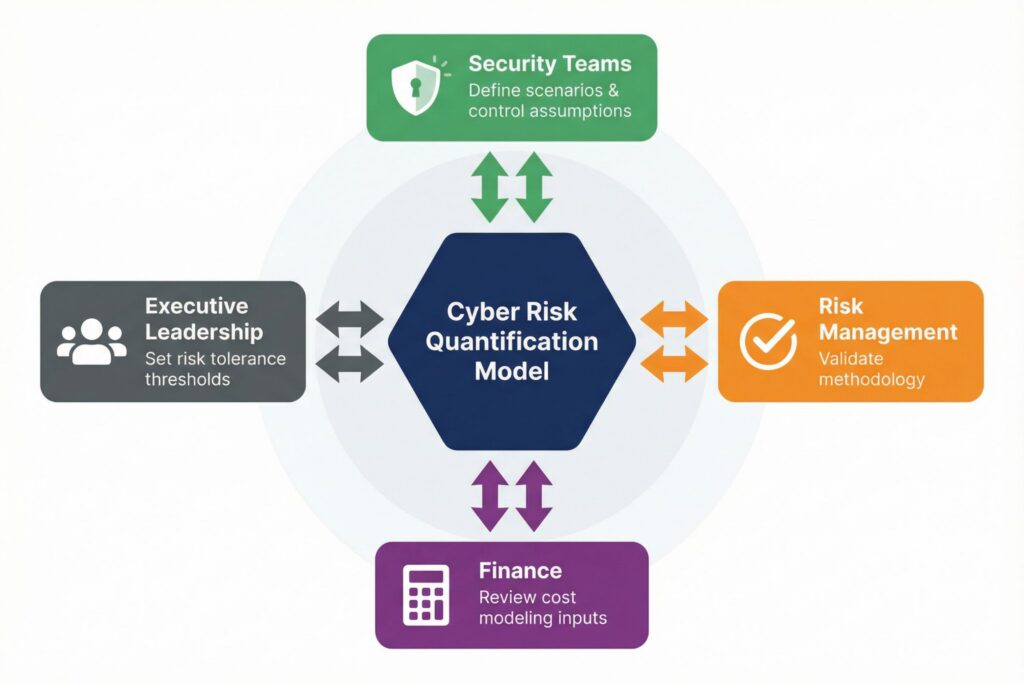
The most common breakdown point is the finance interface, specifically around contested cost categories like reputational damage. Aligning on how each category is defined and estimated before the first model is built prevents that breakdown from derailing the program.
Limits That Practitioners Should Acknowledge
Quantification works best under specific conditions. When those conditions are absent, the output loses reliability. The most common constraints practitioners encounter:
- Sparse incident data. Models built on thin internal history require heavier reliance on industry benchmarks, which may not reflect the organization’s actual threat exposure.
- Rapidly changing environments. New business lines, acquisitions, or technology migrations can outpace model assumptions within months of the last update.
- Poorly documented control posture. If the team cannot accurately describe what controls exist and how consistently they are applied, the likelihood estimates have no solid foundation.
OT and Safety-Critical Systems
For operational technology and safety-critical infrastructure, financial modeling should run alongside safety risk assessments rather than replace them. A dollar figure does not capture the full consequence of a compromised industrial control system — production loss is measurable, but physical safety risk requires a separate analytical framework.
Cloud and Hybrid Environments
Configuration drift is a persistent accuracy problem in cloud and hybrid setups. If the asset inventory feeding the model is outdated, the loss estimates will reflect conditions that no longer exist. Accurate asset visibility is a prerequisite for credible quantification, not an optional enhancement.
Smaller Teams
Teams without dedicated risk analysts can still apply a simplified version. Selecting three to five high-priority scenarios, documenting control assumptions, and modeling conservative loss ranges provides more decision support than arbitrary risk scores — and creates a baseline that improves with each review cycle.
What a mature program looks like over time is not perfect accuracy. It is consistent methodology: scenarios defined the same way each year, assumptions versioned and logged, estimates updated when controls change or new threats emerge. Useful progress indicators include the share of security investments evaluated using modeled loss reduction, the frequency of assumption reviews, and the variance between modeled and actual incident costs. That last metric, tracked honestly over several years, is what builds the model’s credibility with CFOs and audit committees.
Cyber risk quantification does not eliminate uncertainty. It converts uncertainty into structured, documented estimates that executive teams can use in budget decisions, insurance negotiations, and regulatory disclosures. The value is not precision — it is a shared financial language across functions that rarely agree on how to measure risk.
Frequently Asked Questions (FAQ)
No. Larger organizations may have more historical data and dedicated tooling, but smaller teams can apply simplified models using a limited set of high-impact scenarios. The core requirement is documented assumptions and cross-functional input, not scale.
No. Qualitative methods remain useful for broad prioritization and compliance alignment. Quantification adds financial context for major investment decisions and strategic risk discussions.
They are structured estimates, not guarantees. Accuracy improves over time as organizations compare modeled losses against actual incident costs and refine their assumptions accordingly. The purpose is decision support, not prediction.
No. Many organizations begin with structured spreadsheets. Dedicated platforms improve consistency and scalability, but methodology and governance have more influence on output quality than the tool used.
At minimum annually, and immediately following significant changes such as new acquisitions, major technology shifts, or a material cyber incident. Regular updates ensure the model reflects current exposure and actual control maturity rather than conditions from a prior year.
Leave a Reply